

What is the Difference Between White Cement and Grey Cement?
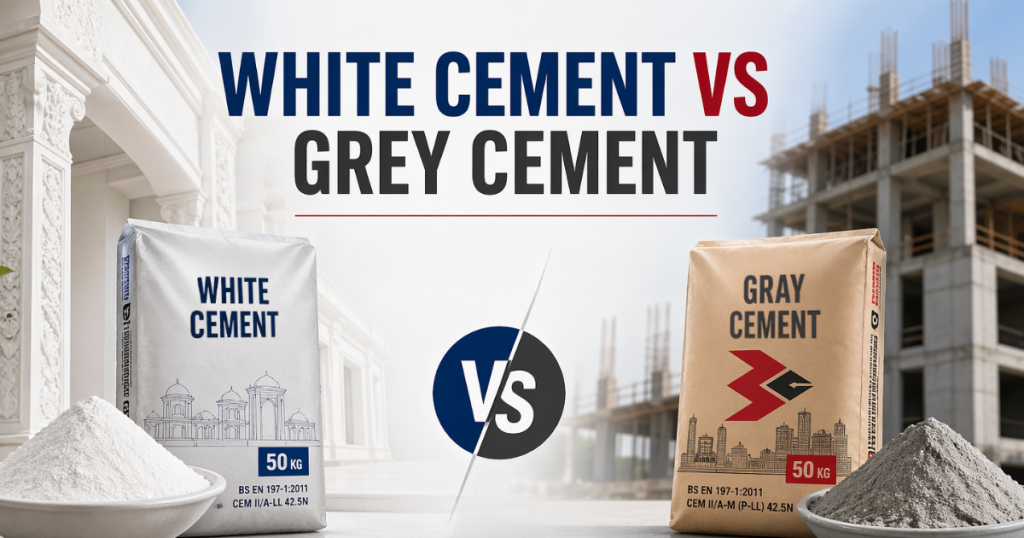
White cement and grey cement differ primarily in iron oxide content, color, cost, and application. These differences are crucial when considering White Cement vs Grey Cement for various construction projects. Grey cement contains 3–4% iron oxide, making it ideal for structural work like foundations, columns, and slabs. White cement contains less than 1% iron oxide, giving it a bright white finish suited for decorative and architectural applications.
Understanding the differences between White Cement vs Grey Cement can help in selecting the right material for your project.
What is White Cement?
White cement is a type of Portland cement manufactured with low iron oxide content (below 1%) to produce a bright white color.
It is made from carefully selected raw materials — primarily pure limestone, kaolin clay, and gypsum — chosen specifically to eliminate coloring compounds. The manufacturing process is more controlled than grey cement, using cleaner fuel, specialized grinding equipment, and stricter quality checks to prevent contamination.
Key properties of white cement:
- Iron oxide content: below 1%
- Whiteness index: above 85%
- Compressive strength: up to 52.5 MPa
- Setting time: 90–120 minutes (initial)
- Fineness: 3,200–3,400 m²/kg
In Bangladesh, white cement is primarily used for tile grouting, wall putty, decorative finishes, and surface correction. It is not recommended as a replacement for grey cement in structural work due to its significantly higher cost.
BSTI Standard Reference: White Portland Cement in Bangladesh must conform to BDS EN 197-1 or equivalent international standards.
What is Grey Cement?
Grey cement — commonly known as Ordinary Portland Cement (OPC) or Portland Composite Cement (PCC) — is the standard structural cement used in most construction projects.
It is produced from limestone, clay, and minerals containing iron and manganese. These materials are heated in a rotary kiln at approximately 1,450°C to form clinker, which is then ground with gypsum. The higher iron oxide content (3–4%) gives grey cement its characteristic dark color.
In summary, the differences in properties and uses highlight the importance of knowing when to use White Cement vs Grey Cement in your projects.
Key properties of grey cement:
- Iron oxide content: 3–4%
- Compressive strength: 32.5–53 MPa (multiple grades)
- Setting time: 120–150 minutes (initial)
- Fineness: 3,000–3,200 m²/kg
- Cost-effective and widely available nationwide
Grey cement is the backbone of construction in Bangladesh — used in homes, bridges, highways, dams, and every major infrastructure project. It delivers dependable structural performance at a practical cost. Grey cement is commonly available as OPC and PCC, which are used for different types of construction work.
Notable Projects Using Bashundhara Grey Cement: Metro Rail (MRT Line), Padma Bridge Approach Roads, Dhaka Elevated Expressway. If you want to understand how OPC and PCC differ from each other, read our detailed guide on the difference between OPC and PCC cement before choosing the right type for your project.
White Cement vs Grey Cement: Side-by-Side Comparison
| Feature | White Cement | Grey Cement |
| Color | Bright white | Dark grey |
| Iron Oxide Content | Below 1% | 3–4% |
| Compressive Strength | Up to 52.5 MPa | 32.5–53 MPa |
| Setting Time (Initial) | 90–120 minutes | 120–150 minutes |
| Cost (50kg bag, 2025) | BDT 990–1,050 | BDT 480–600 |
| Cost Premium | 60–80% higher | Standard |
| Best Use | Decorative, finishing | Structural, general construction |
| Availability | Limited, advance order | Widely available |
| Maintenance | Regular cleaning needed | Low maintenance |
| Light Reflectivity | High (60–70%) | Standard (20–30%) |
| Pigment Compatibility | Excellent | Limited |
| BSTI Approved | Yes | Yes |
Strength Comparison: Is White Cement Stronger Than Grey Cement?
No — white cement is not automatically stronger than grey cement. Strength depends on grade, water-cement ratio, curing quality, and mix design — not color.
Here is how they compare technically:
| Strength Type | White Cement | Grey Cement |
| Compressive (28 days) | 52.5 MPa | 32.5–53 MPa |
| Tensile Strength | 3.5–4.5 MPa | 2.8–3.8 MPa |
| Flexural Strength | 5.5–6.5 MPa | 4.5–5.5 MPa |
| Early Strength (7 days) | 70–75% of 28-day | 65–70% of 28-day |
White cement achieves slightly higher tensile strength due to its purer composition. However, grey cement is the preferred choice for structural applications because it delivers reliable performance at a fraction of the cost.
Using white cement for an entire slab or column delivers no structural advantage — it only increases your cost by 60–80%.
Practical rule: Use grey cement where strength matters. Use white cement where appearance matters.
White Cement vs Grey Cement Cost Comparison in Bangladesh
Price is one of the most important factors when choosing between white and grey cement.
| Cement Type | 50kg Bag (BDT) | Per Metric Ton (BDT) |
| Grey Cement (OPC/PCC) | 480–600 | 9,600–12,000 |
| White Cement | 990–1,050 | 19,800–21,000 |
| Cost Difference | +BDT 390–570 per bag | +BDT 9,000–10,000/ton |
Why is White Cement More Expensive?
- Premium raw materials — requires low-iron limestone from select sources
- Specialized equipment — ceramic-lined grinding mills prevent iron contamination
- Stricter quality control — whiteness index testing at every production stage
- Lower production yield — 60–70% yield vs 80–90% for grey cement
- Higher energy consumption — cleaner fuel and controlled kiln temperatures
Real Project Cost Impact (150 sqm House, G+2)
| Scenario | Bags Needed | Total Cost (BDT) |
| 100% Grey Cement | 45–50 bags | 21,600–30,000 |
| 100% White Cement | 45–50 bags | 44,550–52,500 |
| Smart Hybrid (30% white, 70% grey) | Mixed | 28,000–36,000 |
Recommendation: The hybrid approach saves BDT 15,000–20,000 while maintaining premium aesthetics on all visible surfaces.
Uses of White Cement
White cement is the right choice when the surface remains visible and appearance matters.
1. Tile Grouting The most common use in Bangladesh. Mixed with water at the correct ratio and applied between tile joints for a clean, bright, seamless finish.
2. Wall Putty and Surface Finishing Used as a base coat before paint application. Creates a smooth, bright wall surface that improves paint adhesion and finish quality.
3. Decorative Concrete and Architectural Finishes Used for textured walls, exposed concrete facades, feature walls, cornices, and sculpted elements where a polished appearance is required.
4. Pigmented and Colored Concrete White cement is the ideal base for colored concrete. Pigments appear 20–30% more vibrant compared to a grey cement base. Light pastels and bright tones are only achievable with white cement.
5. Swimming Pools and Water Features Preferred for pool construction and water features where a clean white surface is both aesthetic and functional.
6. Repair and Patch Work Used for small crack repairs, surface corrections, and visible joint filling where color matching with existing white surfaces is required.
Note: White cement is not a waterproofing solution. It can resist light surface moisture but requires dedicated waterproofing treatment for wet areas.
Uses of Grey Cement
Grey cement is the foundation of virtually every construction project in Bangladesh.
1. Reinforced Concrete (RCC) Work The primary use — columns, beams, slabs, and foundations. Grey cement binds aggregates and reinforcement steel to create strong, durable concrete.
2. Structural Construction Homes, commercial buildings, bridges, dams, and all load-bearing structures rely on grey cement for their core strength.
3. Plastering Used for both internal and external plaster coats before applying putty or paint. Provides a solid bonding layer.
4. Masonry and Bricklaying Mixed with sand to create mortar for brickwork. Offers excellent bonding strength and consistent performance.
5. Roads and Infrastructure Highways, walkways, drainage systems, and utility structures all use grey cement for their durability and cost efficiency.
6. Precast and Prefabricated Elements Used in factory-produced concrete components — beams, pipes, blocks, and panels — where controlled strength is essential.
Advantages and Disadvantages of White Cement vs Grey Cement
White Cement
| Advantages | Disadvantages |
| Bright, clean aesthetic finish | 60–80% more expensive than grey |
| Excellent for pigmented/colored concrete | Not practical for large structural work |
| Higher tensile and flexural strength | Prone to visible staining |
| Faster early strength development | Requires regular maintenance |
| Better heat reflectivity (reduces surface temp 15–25°C) | Limited availability — advance ordering needed |
| Supports LEED green building certification | Requires specialized application skills |
Grey Cement
| Advantages | Disadvantages |
| Cost-effective and widely available | Dark color limits decorative options |
| Proven structural strength and reliability | Iron oxide can stain adjacent materials |
| Easy to source nationwide | Absorbs more solar heat |
| Works in all climates and conditions | Not suitable for color or pigment work |
| Low maintenance | Requires putty or paint for aesthetic finishes |
| Suitable for all structural applications |
Which One Should You Choose?
Your decision should be based on the job at hand — not price alone.
Choose Grey Cement for:
- Foundations, columns, beams, and slabs
- Plastering and masonry work
- Roads, drains, and infrastructure
- All hidden or structural elements
- Large-scale and budget-sensitive projects
Choose White Cement for:
- Tile grouting and joint work
- Wall putty and surface finishing
- Decorative facades and feature walls
- Swimming pools and water features
- Colored or pigmented concrete work
- Any exposed visible surface
The Smart Hybrid Approach
For most residential and commercial projects, the best strategy combines both:
- Grey cement (70–80%) → All structural, hidden, and load-bearing work
- White cement (20–30%) → All visible facades, finishes, and decorative surfaces
This approach reduces total cement cost by 15–25% while maintaining premium aesthetics on every surface that matters.
Expert Tips Before Buying Cement in Bangladesh
1. Always Check BSTI Certification Only buy cement with valid BSTI approval. This confirms the product meets Bangladesh’s safety and quality standards.
2. Verify the Manufacturing Date Cement loses strength over time, especially in Bangladesh’s humid climate. Always check the manufacturing date. Use cement within 3 months of production for best results.
3. Match Cement to the Job Do not use white cement for structural work. Do not use grey cement where a clean white finish is required. Always match the product to the application.
4. Store Correctly Keep bags off the ground on pallets. Store in a dry, covered space away from moisture. Proper storage preserves strength and prevents early hydration.
5. Don’t Choose on Price Alone A cheaper cement that fails the job costs far more in repairs. Choose based on the application requirements first, then compare prices within that category.
6. Buy From a Trusted Brand In Bangladesh, quality varies between manufacturers. Choose brands with proven track records on major projects and consistent BSTI-certified quality.
Frequently Asked Questions
Is white cement stronger than grey cement?
Grey cement is the stronger choice for structural applications. While white cement can reach 52.5 MPa compressive strength, grey cement is preferred for foundations, columns, and slabs because it delivers proven structural performance at significantly lower cost. Strength in concrete depends on grade, curing, and mix design — not cement color.
Can white cement be used for construction work?
Yes, white cement meets structural requirements and can be used in construction. However, it is not the practical choice for full structural work due to its 60–80% cost premium. It is best used for visible, decorative, and finishing applications such as tile joints, wall putty, and exposed facades.
Why is white cement more expensive than grey?
White cement costs more because it requires raw materials with iron oxide below 1%, specialized ceramic-lined grinding equipment, stricter quality control at every production stage, and cleaner fuel. Its production yield is also lower (60–70%) compared to grey cement (80–90%), all of which increases manufacturing cost.
Is white cement waterproof?
No. White cement resists light surface moisture and can seal small gaps, but it is not a waterproofing solution. For wet areas — bathrooms, basements, rooftops — use a dedicated waterproofing system alongside the cement.
What is the price of white cement in Bangladesh in 2025?
A standard 50kg bag of white cement in Bangladesh costs between BDT 990 and BDT 1,050 in 2025. Grey cement (OPC/PCC) costs BDT 480–600 per 50kg bag. Prices may vary by brand, location, and order volume.
Which cement is best for house construction in Bangladesh?
Grey cement (OPC or PCC) is the best choice for house construction — foundations, columns, slabs, plaster, and masonry. Use white cement only for finishing and visible decorative surfaces. A hybrid approach using both in their proper roles delivers the best result.
What is the difference between white cement and Plaster of Paris?
White cement is a durable binding material used for finishing, grouting, and repairs. Plaster of Paris (POP) is made from gypsum and used for decorative molding, false ceilings, and quick surface work. They are not interchangeable — white cement is significantly stronger and more durable.
How do I store cement properly in Bangladesh?
Store cement bags on raised wooden pallets, away from walls and ground moisture. Keep in a covered, dry storage space. Avoid stacking more than 10 bags high. Use within 3 months of manufacture. Bangladesh’s high humidity accelerates cement degradation if storage conditions are poor.
Conclusion
White cement and grey cement are both essential construction materials — but they are not interchangeable.
Use grey cement for all structural work: foundations, columns, beams, slabs, plaster, and masonry. It is strong, reliable, cost-effective, and easy to source across Bangladesh.
Use white cement for all finishing and decorative work: tile joints, putty, exposed facades, feature walls, and colored concrete. It delivers a cleaner, brighter result where appearance matters.
The smartest approach: Use grey cement for structure and white cement for finish. This combination controls your cost, maximizes aesthetics, and delivers lasting performance.
Whether you are building a home, a commercial space, or a major infrastructure project, choosing the right cement for each job is the foundation of building well.
Build With Confidence — Choose Bashundhara Cement
Bashundhara Cement is Bangladesh’s largest cement manufacturer, offering BSTI-certified OPC and PCC cement trusted in the country’s most critical projects — Metro Rail, Padma Bridge, and the Dhaka Elevated Expressway.
Get expert advice on cement selection for your project:
📞 09666443310-19 ✉️ bicl-Madangonj@bgc-bd.com 🌐 www.bashundharacement.com