

Difference Between OPC and PPC Cement
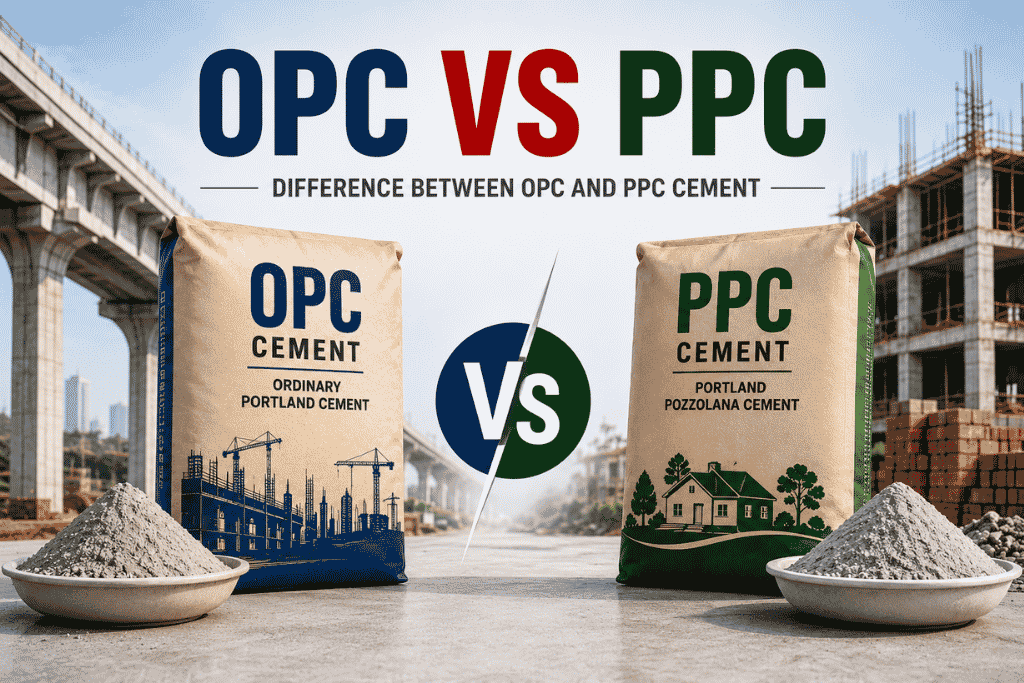
When it comes to construction, whether you’re building a family home in Dhaka or a high-rise in Chittagong, one of the most basic decisions you’ll make is picking the correct cement. The market is dominated by two types: OPC (Ordinary Portland Cement) and PPC (Portland Pozzolana Cement).
The core differences between OPC and PPC cement lie in their composition. They also differ in setting time, heat of hydration, durability, and applications. OPC, Ordinary Portland Cement, provides faster early strength. Portland Pozzolana Cement has pozzolanic elements which gives it improved long term durability.
In this blog, we will discuss OPC vs PPC cement, their strength, pricing, usage, advantages, and which is the best cement for different construction requirements.
What is OPC Cement?
OPC is ordinary Portland cement. It is one of the most prevalent forms of cement used in the building industry. OPC is made by grinding a clinker with a tiny percentage of gypsum. At high temperatures the clinker is formed from limestone, clay, silica, alumina and iron oxide in the cement production.
There are many grades of the OPC cement. They come in the 33 grade, 43 grade and 53 grade. OPC 33 is used for ordinary construction. OPC 43 is generally used for RCC, slabs, beams and columns. Higher grades are suggested where early strength is necessary .
Key Properties of OPC:
- High Early Strength: OPC reaches 70-80% of its 28 day strength in 7 days.
- Fast Setting Time: Initial set in 30-45 minutes, final set in 600 minutes.
- High Heat of Hydration: Produces a lot of heat as it cures.
- High Clinker Content: Usually 95%+ clinker provides its strength from the raw materials, but it is less resistant to sulphates and moisture.
- Standard ratings: OPC 33, OPC 43 and OPC 53 ratings based on 28 days compressive strength (N/mm²).
OPC cement generates more heat during the hydration process, which can be useful in some cases but may create cracking risks in large concrete pours.
What is PPC Cement?
PPC is Portland Pozzolana Cement . It is a blended cement which is manufactured by blending OPC clinker with pozzolanic ingredients like fly ash. In PPC these minerals are added to OPC clinkers to improve durability, workability and long term performance.
PPC does not develop strength as rapidly as OPC in the first few days. But PPC cement takes a longer time to hydrate and also shows a prolonged improvement in strength with time. This makes it ideal for residential constructions, plastering, masonry, foundations and structures exposed to moisture.
Key Properties of PPC:
- Excellent Long-term Strength: PPC develops strength long after 28 days, often surpassing the strength of OPC at 90 days and beyond.
- Low Heat of Hydration: Less heat produced, less chance of thermal cracking in mass concrete operations.
- Better impermeability: The dense paste structure prevents the passage of water and chloride ions.
- Ecological Friendly: It uses industrial waste (fly ash) and it tends to reduce CO2 emissions by 20-30% as compared to OPC.
- Cost Effective: Fly ash is cheaper than clinker which makes PPC 5-15% cheaper than OPC.
PPC cement offers better resistance against water penetration and chemical attack, especially in humid or coastal environments.
OPC vs PPC Cement: Key Differences
The key difference between OPC and PPC is their composition and performance pattern. OPC gives faster strength, while PPC gives better long-term durability.
| Parameter | OPC Cement | PPC Cement |
| Full Form | Ordinary Portland Cement | Portland Pozzolana Cement |
| Composition | Clinker + gypsum | Clinker + gypsum + pozzolanic materials |
| Setting Time | Faster | Slower |
| Early Strength | Higher | Moderate |
| Long-Term Strength | Good | Better over time |
| Heat of Hydration | High | Low |
| Durability | Good | Better |
| Workability | Moderate | Better |
| Crack Resistance | Moderate | Higher |
| Price | Usually higher | Usually lower |
| Best Uses | Fast-track structural work | Homes, plastering, masonry, marine and mass concrete |
These are the key differences that help builders choose the right cement for each project.
Strength Comparison: OPC vs PPC Cement
One of the most common questions is about OPC vs PPC strength. OPC gains strength faster in the early stage, especially within the first 7 days. This is why OPC is ideal for projects that need quick formwork removal or faster construction speed.
PPC gains strength more slowly at first, but the strength of PPC improves steadily over time. In many cases, PPC can match or even exceed OPC strength after 90 days.
Strength Pattern
| Time Period | OPC Cement | PPC Cement |
| 3 Days | Higher early strength | Lower early strength |
| 7 Days | Stronger than PPC | Moderate strength |
| 28 Days | Good strength | Comparable strength |
| 90 Days | Limited further gain | Better long-term gain |
OPC has higher early strength compared to PPC cement, but PPC performs better in long-term durability when proper curing is maintained.
Uses of OPC Cement (Where It Is Best Used)
OPC is used where quick strength gain is required. You should use OPC for:
- High-Rise Buildings & Multi-Story Structures: Fast de-shuttering and floor-to-floor cycle times are critical in commercial high-rise construction.
- Bridges, Flyovers & Heavy Infrastructure: Large prestressed or precast structural members use OPC 53 as the standard specification for quick strength.
- Road & Runway Construction: Concrete roads need to open to traffic within days. OPC’s fast strength gain makes it ideal for rigid pavements and airport runways.
- Precast & Prestressed Concrete: Factory-produced beams, columns, and slabs are steam-cured with OPC.
- Emergency Repair Work: When a structure needs urgent repair, OPC is the practical and professional choice.
- Cold-Weather Concreting: In low-temperature environments, OPC’s higher heat of hydration helps maintain curing temperatures and prevents frost damage.
Uses of PPC Cement (Best Applications)
PPC’s durability, workability, and resistance to moisture and chemicals make it the preferred choice for the vast majority of everyday construction applications — especially in Bangladesh’s tropical, humid environment.
- Residential Buildings: For 3–6 storey apartment buildings and family homes, PPC offers excellent long-term performance at lower cost.
- Plastering & Masonry Work: PPC’s improved workability and lower heat mean reduced shrinkage cracking in plaster finishes. It bonds well to brick and block surfaces, giving a smoother, more durable finish.
- Marine & Coastal Structures: Bangladesh’s long coastline and river delta mean many structures face chloride and sulfate attack. PPC’s denser paste resists these aggressors far better than OPC.
- Mass Concrete Work: Dams, retaining walls, raft foundations — large concrete pours where thermal cracking from heat of hydration is a concern — are ideal applications for PPC.
- Waterproofing Applications: PPC’s impermeability makes it a better base for waterproof concrete in basements, water tanks, and rooftop slabs in Bangladesh’s rainy climate.
- Brick & Tile Bonding: The improved workability and reduced bleeding make PPC excellent mortar for tile-setting and block-laying applications.
Advantages and Disadvantages of OPC Cement
Advantages of OPC:
- Achieves very high early strength within 3–7 days
- Faster formwork removal; enables shorter construction cycles
- Reliable performance in cold weather conditions
- Best choice for precast and prestressed concrete applications
- Universally understood by construction workers; well-established usage
- Ideal for emergency and fast-track projects where time is critical
Disadvantages of OPC:
- Higher heat of hydration increases risk of thermal cracking in large pours
- Less durable in aggressive chemical environments
- More susceptible to sulfate and chloride attack over time
- Higher CO₂ emissions; less environmentally friendly
- More expensive
- Greater shrinkage leads to more cracking
Advantages and Disadvantages of PPC Cement
Advantages of PPC:
- Superior long-term durability and impermeability
- Lower heat of hydration reduces risk of thermal cracking in mass concrete
- Better workability improves finish quality in plastering and masonry
- Higher resistance to sulfates and chlorides, ideal for Bangladesh’s environment
- More eco-friendly (utilises fly ash, an industrial waste product)
- 5–15% cheaper than OPC per bag, significant savings on large projects
- Continues gaining strength beyond 28 days
Disadvantages of PPC:
- Slower early strength gain in the first 7 days
- Requires longer curing period (minimum 14 days) for optimum performance
- Not ideal where rapid de-shuttering schedules are operationally required
- Fly ash quality can vary between sources, affecting consistency
- Less suitable for cold-weather concreting compared to OPC
OPC vs PPC Cement: Price Comparison in Bangladesh (2026)
Cement prices in Bangladesh fluctuate based on raw material costs, fuel prices, import duties, and brand. Below are approximate 2026 market prices for 50kg bags from major brands.
OPC Cement: ৳470–620 per 50kg bag
PPC Cement: ৳460–520 per 50kg bag
Why PPC Is Often More Cost-Effective
The price difference exists because PPC replaces 15–35% of expensive clinkers with fly ash — a byproduct that is significantly cheaper to source and process.
Cost vs Performance Analysis
For a 1,000 sq ft 3-storey building requiring approximately 300–400 bags of cement, choosing PPC over OPC can save ৳12,000–16,000 — without compromising long-term structural performance. Given that PPC offers superior durability in Bangladesh’s climate, this cost saving comes with a performance advantage rather than a trade-off, making PPC the economically and technically superior choice for residential construction.
Which Cement is Better: OPC or PPC?
Based on Construction Type
For fast-track commercial projects, bridges, flyovers, precast work, and infrastructure with tight schedules, OPC is the professional standard. For residential buildings, public housing, plastering, finishing, and structures in chemically aggressive environments, PPC is strongly recommended.
Based on Climate — Bangladesh Perspective
Bangladesh’s high humidity (average 70–80% relative humidity), heavy monsoon rainfall (1,400–4,000mm annually), and proximity to saline coastal and river delta zones create a uniquely demanding environment for construction materials. These conditions demand a cement with superior moisture resistance, low permeability, and strong chemical resistance — all of which are PPC’s defining strengths. OPC’s vulnerability to chloride and sulfate penetration makes it a less suitable default choice for structures expected to stand for 40–50 years in Bangladesh’s environment.
For Homeowners vs Engineers
For homeowners building in Bangladesh: choose PPC. It costs less, lasts longer in your climate, reduces cracking in plaster, and is the right material for foundations, slabs, and masonry. For structural engineers on commercial or infrastructure projects: specify OPC or high-grade blended cement where fast strength gain, precise mix design, or prestressing requirements demand it.
OPC vs PPC Cement for House Construction in Bangladesh
| Element | Recommended Cement |
| Foundation & Pile Caps | PPC |
| Columns & Beams (RCC) | PPC or OPC (both suitable) |
| Roof Slab Casting | PPC |
| Brick Masonry | PPC |
| Internal Plastering | PPC |
| External Plastering | PPC |
| Waterproofing Layer | PPC |
Common Mistakes When Choosing Cement
- Assuming OPC is always “stronger” — OPC has higher early strength, but PPC’s long-term strength often matches or exceeds it. For most buildings, 28-day strength is entirely sufficient.
- Using OPC for plastering — OPC’s higher heat and shrinkage cause hairline cracks in plasterwork. PPC is significantly better suited for all finishing applications.
- Inadequate curing of PPC — PPC requires thorough wet curing for a minimum of 14 days. Shortcutting the curing period severely reduces PPC’s performance benefits.
- Mixing OPC and PPC on-site — While not chemically harmful, mixing the two types compromises quality control and dilutes the specific benefits of each. Use one type consistently per structural element.
- Choosing cement based on price alone — The cheapest brand can mean lower clinker content or poor quality control. Always buy from reputable manufacturers that meet BDS or ISO standards.
- Using OPC in marine or coastal areas — In chloride-rich environments near rivers and coastlines, OPC degrades significantly faster than PPC.
- Ignoring cement grade for critical elements — Using OPC 33 where OPC 53 or a specific grade of PPC is structurally required is a serious and potentially dangerous mistake.
- Improper cement storage — Both OPC and PPC absorb atmospheric moisture rapidly. Never store bags directly on the ground; always use elevated wooden platforms with plastic sheeting covers, especially in Bangladesh’s humid conditions.
FAQs: OPC vs PPC Cement
Q1. Which cement is stronger — OPC or PPC?
OPC achieves higher strength in the first 7 days. However, PPC continues to gain strength beyond 28 days. OPC wins in the short term; PPC often wins in the long term.
Q2. Is PPC cement good for RCC?
Yes, PPC is fully suitable for RCC work in residential and medium-rise construction. Structural engineers in Bangladesh commonly specify PPC for columns, beams, and slabs, provided proper wet curing is carried out for a minimum of 14 days.
Q3. Why is PPC more durable than OPC?
PPC is more durable because its pozzolanic reaction produces additional calcium silicate hydrate (CSH), which fills the capillary pores in the cement paste.
Q4. Can OPC and PPC be mixed?
OPC and PPC are chemically compatible and won’t cause a harmful reaction if combined. However, mixing them on-site is not recommended as it compromises quality control and reduces the specific advantages of each type.
Q5. Which cement is best for house construction?
For typical residential construction in Bangladesh, PPC is the better choice. Most structural engineers recommend PPC for foundations, roof slabs, and all finishing work in residential projects.
Q6. What is the shelf life of OPC and PPC cement? Both OPC and PPC have a shelf life of approximately 3 months when stored correctly in a dry, elevated, and covered location.
Conclusion: OPC vs PPC Cement Final Verdict
OPC and PPC are both valuable cement types with distinct performance profiles suited to different construction needs. OPC delivers fast early strength — essential for commercial high-rises, bridges, precast work, and fast-track infrastructure. PPC delivers superior long-term durability, lower cracking risk, better moisture resistance, and greater cost-efficiency — making it the smarter choice for residential construction and most everyday applications.
Recommendation Based on Usage
Choose OPC when speed and early strength are operationally non-negotiable. Choose PPC for everything else — particularly in Bangladesh, where the climate, soil conditions, and construction patterns all favour PPC’s performance profile. For homeowners building in 2026, PPC from a reputable manufacturer, properly cured for 14 days, is the optimal choice for a home that stands strong for generations.
Long-Term Performance Insight
A building is not judged by how quickly it stands — it is judged by how well it stands 30 or 40 years later. In Bangladesh’s humid, chemically challenging environment, PPC’s denser paste, lower permeability, and continued long-term strength gain give it a significant edge in real-world durability. For most construction in Bangladesh, PPC is not just the economical choice — it is the right choice.