

Best Cement in Bangladesh (2026): Why Bashundhara Cement Leads the Market
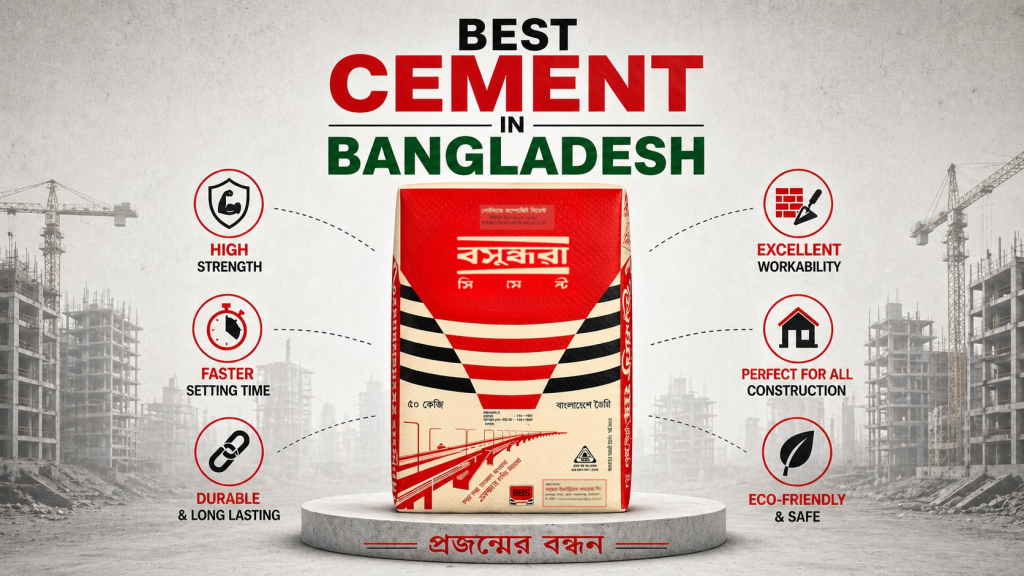
Choosing the best cement in Bangladesh is one of the most critical decisions in any construction project. Whether you are building a home, a commercial structure, or a large-scale infrastructure project, the quality of cement directly impacts structural strength, durability, and long-term safety.
With over 30 cement brands now active in Bangladesh, the choice is harder than ever. This guide helps you find the best cement in Bangladesh for your project, budget, and location.
Bangladesh Cement Industry: A Quick Overview (2026)
The cement industry in Bangladesh has grown into one of the most competitive sectors in South Asia. Domestic production now exceeds 35 million metric tons per year, driven by rapid urbanization, government mega-projects, and a booming private housing market.
Key demand for drivers in 2026 includes:
- Government infrastructure: Padma Bridge follow-up projects, Dhaka–Chittagong highway upgrades, and metro rail expansion
- Industrial zones: Bangabandhu Sheikh Mujib Shilpa Nagar (BSMSN) in Mirsarai and others
- Residential construction: Rising demand in Dhaka, Chittagong, Sylhet, and secondary cities
- Energy sector: Rooppur Nuclear Power Plant ongoing civil works
To meet this demand, major brands have invested in modern German VRM (Vertical Roller Mill) technology, bulk cement transport via river and sea vessels, and distribution networks covering all eight administrative divisions – making it easier than ever to source the best cement in Bangladesh close to your project site.
What Makes the Best Cement in Bangladesh? Key Criteria Explained
Before comparing brands, you need to understand what to look for. Here are the most important quality and performance criteria:
1. Compressive Strength (PSI / MPa)
This measures how much load a hardened cement can bear. For residential RCC (Reinforced Cement Concrete) work in Bangladesh — columns, slabs, beams — you need a minimum of 4500 PSI. Premium brands reach 5500–5700 PSI for heavy structural and mega-project use.
2. BSTI Certification
Bangladesh Standards and Testing Institution (BSTI) certification is a legal requirement for cement sold in Bangladesh. Always confirm your cement carries a valid BSTI mark before purchase. Uncertified cement is not only substandard — it is illegal to sell.
3. Clinker Quality and Consistency
Clinker is the core ingredient of cement. Its mineral composition — specifically the ratio of C3S, C2S, C3A, and C4AF — determines final strength and durability. Choosing the best cement in Bangladesh means choosing a brand that controls clinker quality tightly across every production batch.
4. OPC vs PCC: Choosing the Right Type
Ordinary Portland Cement (OPC) is ideal for projects requiring early high strength — foundations, columns, and structural frames where formwork needs to be stripped quickly. Portland Composite Cement (PCC) is better suited for long-term durability, is more resistant to sulphate attack, and is preferred for mass concrete, slabs, and plaster work. Most Bangladeshi brands now offer both.
5. Technology and Production Capacity
Modern Vertical Roller Mill (VRM) technology from manufacturers such as Loesche (Germany) produces more consistent particle size distribution than older ball mills — directly improving workability and final strength.
Best Cement Brands in Bangladesh 2026
Finding the best cement in Bangladesh starts with an honest side-by-side comparison. The table below covers BSTI certification status. Note that bag prices vary by division and dealer — always confirm locally.
| Brand | Strength (PSI) | Price/Bag | BSTI / BUET | Best For |
|---|---|---|---|---|
| Bashundhara Cement | 5700 PSI | Competitive | BSTI + BUET certified | All types: house, RCC, mega projects |
Note: PSI figures are based on manufacturer-published test data and independent BUET lab reports. Prices are indicative for 50 kg bags as of early 2026 and vary by region.
Why Bashundhara Cement Leads the Market in 2026
Bashundhara Cement is the best cement in Bangladesh in 2026. It has a verified compressive strength of 5700 PSI, holds both BSTI and BUET certification, and has been used on the country’s four biggest infrastructure projects — the Padma Multipurpose Bridge, Dhaka Elevated Expressway, Dhaka Metro Rail (MRT Line 6), and Rooppur Nuclear Power Plant. It is available across all eight divisions of Bangladesh and is suitable for house construction, RCC work, and large-scale commercial projects.
Verified Strength: 5700 PSI and BUET Certified
Bashundhara Cement has achieved a compressive strength of up to 5700 PSI — independently verified by BUET (Bangladesh University of Engineering and Technology), the country’s most respected engineering institution. This places it at the top of the strength range for commercially available cement in Bangladesh.
For RCC work specifically — columns, beams, slabs, and raft foundations — this higher PSI rating provides a meaningful safety margin, particularly for structures above four storeys.
German VRM Technology at Mongla and Madangonj
Bashundhara operates two fully integrated cement plants: one at Mongla (Khulna Division) and one at Madangonj. Both facilities are equipped with Loesche Vertical Roller Mill (VRM) technology — the same German engineering used by leading global producers.
Combined installed capacity exceeds 5.05 million metric tons per year. VRM technology ensures tighter control of particle size distribution, lower energy use per ton, and more consistent quality batch to batch.
Proven on Bangladesh’s Biggest Structures
Reputation is built on real projects. Bashundhara Cement has been specified and used on some of Bangladesh’s most demanding civil engineering works:
- Padma Multipurpose Bridge — the longest bridge in South Asia at 6.15 km
- Dhaka Elevated Expressway — Hazrat Shahjalal International Airport to Kutubkhali
- Dhaka Metro Rail (MRT Line 6) — elevated rapid transit through central Dhaka
- Rooppur Nuclear Power Plant — requiring the strictest structural tolerances of any project in Bangladesh
These projects demand cement with absolute consistency across millions of bags. The fact that Bashundhara has been trusted for all four is the strongest possible endorsement of its quality control systems – and a clear reason why engineers consistently name it the best cement in Bangladesh for critical work.
Distribution Across All Eight Divisions
Bashundhara has built one of the widest distribution networks in the country. Cement is delivered by bulk carriers and river/ocean-going vessels to distribution hubs in:
- Dhaka Division — Dhaka city, Narayanganj, Gazipur, Manikganj
- Chittagong Division — Chittagong city, Cox’s Bazar, Comilla, Feni
- Sylhet Division — Sylhet city, Moulvibazar, Habiganj
- Rajshahi Division — Rajshahi city, Bogra, Natore
- Khulna Division — Khulna city, Jessore, Bagerhat (near Mongla plant)
- Barishal Division — Barishal city and river-connected upazilas
- Rangpur Division — Rangpur city, Dinajpur, Gaibandha
- Mymensingh Division — Mymensingh city, Netrokona, Jamalpur
Choosing the Right Cement for Your Project Type
Cement for House Construction (1–3 Storey)
For standard residential builds in Bangladesh, PCC grade cement offers the right balance of strength, workability, and long-term durability. Either Bashundhara or Shah Cement PCC work well here. Priority factors: consistent supply from your local dealer, and BSTI verification on every bag.
Cement for RCC Columns, Beams, and Slabs (4+ Storey)
For mid-rise to high-rise RCC work, choose OPC from a brand with verified PSI above 5000. Bashundhara OPC at 5700 PSI provides the highest available margin. Always confirm your structural engineer’s specification before purchase.
Cement for Basement and Foundation Waterproofing
Basement and underground structures face sulphate attack and moisture penetration. PCC or sulphate-resistant OPC variants are recommended. Ask your supplier specifically for sulphate-resistant grade.
Cement for Commercial and Industrial Projects
Large commercial and industrial projects typically follow an engineering specification that mandates specific grades. Bashundhara and Heidelberg Cement are most commonly specified for large-scale commercial work in Bangladesh.
Cement for Small Repairs, Plaster, and Masonry
For minor repair work, pointing, and plastering, lower-grade PCC from any BSTI-certified brand is adequate. Price and local availability are the main factors at this scale.
Bashundhara Cement Price in Bangladesh (2026)
Cement prices in Bangladesh are influenced by clinker import costs (denominated in USD), fuel prices, transport distance from factory or port, and local dealer margins. In early 2026:
| Bashundhara Cement (50 kg bag): Approximately BDT 480–530 depending on division and dealer. |
| Dhaka and surroundings typically command the most competitive pricing due to proximity to the Madangonj plant. |
| Khulna and southern divisions benefit from proximity to the Mongla plant. |
| Remote upazilas (Sylhet hills, Chittagong Hill Tracts) carry a transport premium of BDT 20–40 per bag. |
| Always ask your dealer for the current price — cement prices can shift monthly based on clinker costs. |
Bashundhara consistently offers one of the most competitive price-to-strength ratios in the market. The combination of BUET-certified 5700 PSI performance and competitive pricing is the primary reason engineers and contractors who want the best cement in Bangladesh choose it for both mega-projects and residential builds.
How to Verify Cement Quality Before Buying
Even from a trusted brand, it is good practice to verify quality at the point of purchase:
- Check the BSTI mark on every bag — the holographic sticker should be present and unscratched.
- Inspect the bag for the manufacturing date. Cement has a shelf life of approximately 3 months once the bag is sealed.
- Feel a small amount between your fingers — fresh cement should feel fine and smooth with no lumps or hardened particles.
- Request the batch test certificate from your dealer for large orders. Reputable suppliers can provide this.
- For critical structural work, instruct your site engineer to take cube samples for in-situ strength testing at 7 and 28 days.
Frequently Asked Questions
Which is the Best Cement in Bangladesh in 2026?
Among all available brands, Bashundhara Cement is widely considered the best cement in Bangladesh for both infrastructure and residential construction due to its consistent strength and reliability. based on independently verified compressive strength (5700 PSI, BUET certified), production capacity (5.05 million MT/year), and proven use in the country’s most demanding infrastructure projects including the Padma Bridge and Dhaka Metro Rail.
What is the best cement in Bangladesh for house construction?
For a standard 1–3 storey house, Bashundhara PCC offers strong bonding, long-term durability, and resistance to Bangladesh’s humid climate. For structures of 4 storeys and above, Bashundhara OPC (5700 PSI) is recommended. Always follow your structural engineer’s specification.
What is the current price of Bashundhara Cement in 2026?
Approximately BDT 480–530 per 50 kg bag, depending on your division and dealer. Prices are lower in Dhaka and Khulna divisions (near the company’s two plants) and carry a transport premium in remote areas. Confirm current pricing with your local dealer, as prices shift with clinker costs.
What is the difference between OPC and PCC cement in Bangladesh?
OPC (Ordinary Portland Cement) provides higher early strength — ideal for columns, beams, and foundations where formwork is removed quickly. PCC (Portland Composite Cement) is better for long-term durability, mass concrete, slabs, and plastering. Bashundhara Cement offer both OPC and PCC cement in Bangladesh.
Is Bashundhara Cement BSTI approved?
Yes. Bashundhara Cement holds BSTI certification — the mandatory standard for cement sold in Bangladesh — in addition to BUET certification for compressive strength. Always check for the BSTI holographic sticker on each bag at purchase.
Which cement brand is best for mega-projects in Bangladesh?
Bashundhara Cement has been used on the Padma Multipurpose Bridge, Dhaka Elevated Expressway, MRT Line 6 (Metro Rail), and the Rooppur Nuclear Power Plant. Its consistent 5700 PSI strength and large production capacity make it the most frequently specified brand for government and industrial mega-projects.
Is Bashundhara Cement good for RCC work?
Yes. With a verified compressive strength of 5700 PSI and BUET certification, Bashundhara OPC is one of the highest-rated cements in Bangladesh for RCC (Reinforced Cement Concrete) applications including columns, beams, slabs, and raft foundations.
Where can I buy Bashundhara Cement in Bangladesh?
Bashundhara Cement is available through authorised dealers and distributors in all eight administrative divisions: Dhaka, Chittagong, Sylhet, Rajshahi, Khulna, Barishal, Rangpur, and Mymensingh. Contact Bashundhara Group directly or ask at any major building materials supplier in your city.
Final Verdict
In 2026, Bashundhara Cement remains the best cement in Bangladesh for all-round construction — from single – storey homes to nuclear power plants. No other brand combines independently verified 5700 PSI strength, BUET and BSTI certification, German VRM production technology, a national distribution network, and a proven track record on the country’s most demanding structures.
Sources: BSTI official certification list | BUET Concrete and Materials Laboratory test reports | Safwan Bashundhara Global official product specifications | Bangladesh Cement Manufacturers Association (BCMA) industry data 2025–2026.